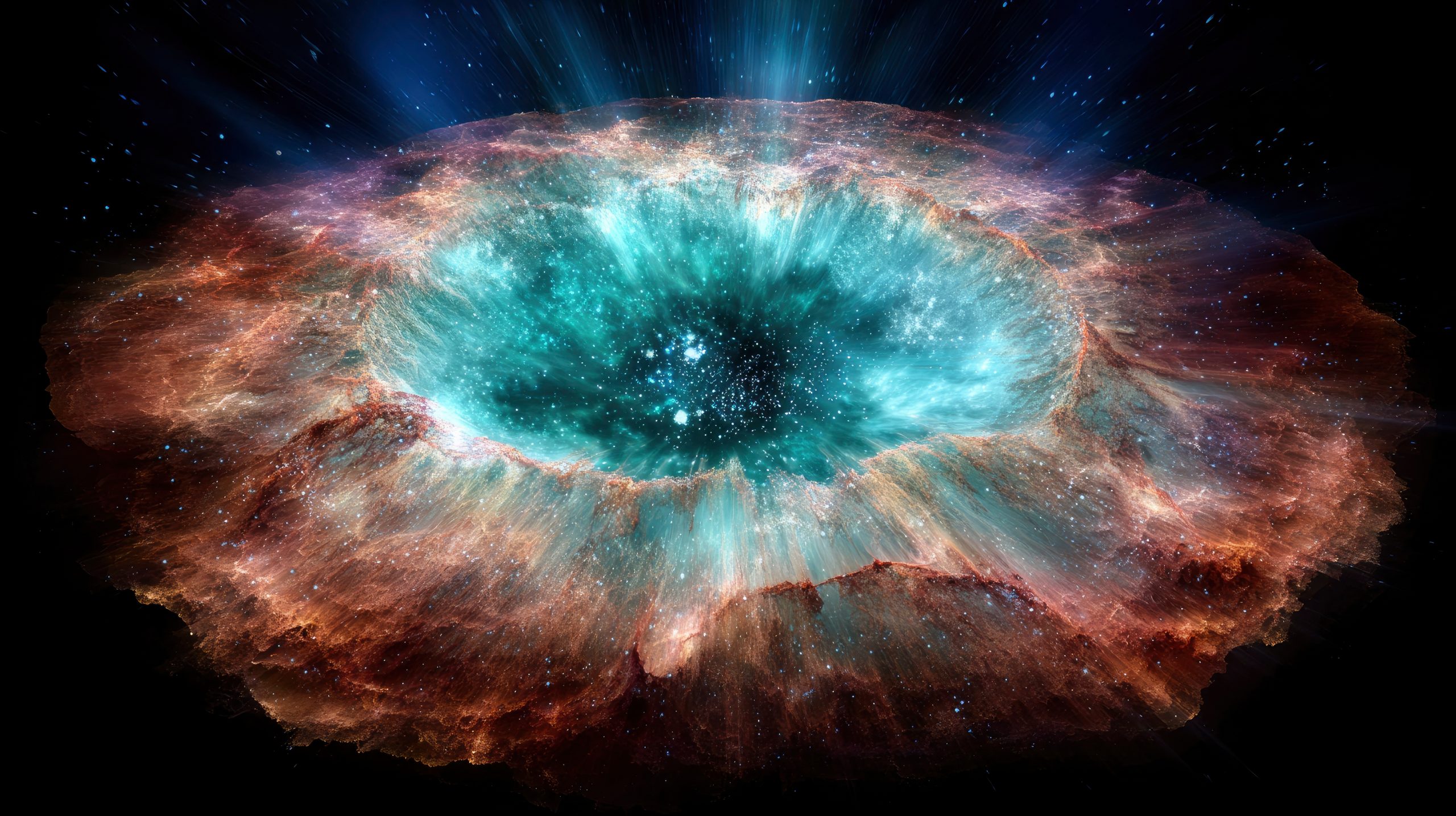
Are we trapped inside a giant space bubble?
Recent research suggests that Earth and the Milky Way may be located in a cosmic void. While the void itself is about 1-2 billion light years wide, this uniquely sparse region of space sees fewer galaxies and matter than the rest of the universe. Due to the higher density of galaxies, the gravitational pull has slowly emptied the region over time.
This discovery is interesting for three reasons:
- It may solve the ‘Hubble tension’ puzzle where scientists have measured two different expansion rates of the universe. One from the afterglow of the Big Bang and one from looking at nearby stars and galaxies, but these numbers have not lined up. If we are in fact in a cosmic void this would explain why those measurements seem incorrect.
- The disagreement about expansion rates also changes how scientists calculate the age of the universe, currently estimated at 13.8 billion years. A more accurate figure can be calculated using the cosmic void theory for a clearer sense of when the first stars formed.
- The general consensus is that the universe largely looks the same, and operates in the same way, everywhere. The cosmic void theory lets us challenge that idea, revealing that our patch of space might be quite different. Perhaps this only poses more questions then it answers, like what’s different in our neighbouring galaxies, and how would the rules of physics change there?
Perhaps the most interesting element of the theory is that Earth may be a uniquely special place to be. Our understanding of the universe has come along way since we though that Earth was the centre of everything, but now the script has flipped again, just at a much larger scale! There is still a lot of mystery in the universe which perhaps can only be uncovered from our position.
If we are in a cosmic void it opens up new avenues for discovery, enabling scientists to use new instruments for deeper galaxy surveys. This is an exciting time where some of the biggest cosmic questions may be answered in our lifetime.