Getting offshore wind spinning
Wind power conjures up the image of towering turbines. But the technology that we see is just one part of an ecosystem of solutions and innovations. With wind power growing in the UK, it’s worth taking a look at technologies that will cut costs and boost productivity in how turbines are built, connected and maintained.
Offshore drone logistics
Transporting, assembling and maintaining components in the nacelle is a challenge as wind turbines get taller and more powerful. When maintaining turbines and lifting spares of up to 200 kg, conventional lifting processes are risky, expensive and time consuming and can require complex logistics.
Most towers have a crane hanging from the top of the nacelle, but these are only suitable for small spares, tools and toolboxes. Some towers have an internal service lift certified to carry a person, but space and payload will be limited and moving equipment would require at least one operator at the top and bottom to load and unload safely.
Other towers have internal electric hoists for up to 500kg but this requires operators to manipulate bulky equipment through the tower door.
Heavy-lift drones are also an option. Most are limited to 70kg – but there’s a new player in the market that is targeting payloads of 100 kg, and up to 200 kg in the future.
Lance Russell, Chief Technology and Operations Officer at Skylift, specialises in taking advanced drone technology from concept to reliable, scalable operations for major organisations.
Russel says: “Every turbine installation and maintenance operation depends on getting the right people, tools and equipment to the right place at the right time. Something as simple as delivering a replacement part can require extensive handling and lifting, adding cost, delays, safety risk and unnecessary emissions. Drone logistics can simplify that process, making offshore operations faster, safer and more efficient, and will have an important role to play as the UK’s offshore wind sector grows.”
Robotic welding cells for offshore fabrication
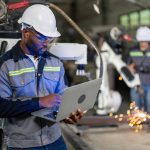
Traditionally, welding has always been carried out onshore, before transporting completed fabrications out to site. However, there’s a growing trend for robotic welding cells to be installed offshore.
William Reid, Head of Technical Sales at robotic welding company CyberWeld explains: “We’re experiencing demand for robotic welding cells on offshore platforms or vessels. This simplifies logistics as it’s easier to transport steel bar, plate and coils than it is to transport bulky fabrications.”
Autonomous offshore survey data
Every offshore wind farm needs detailed information about year-round weather conditions, sea state, seabed changes and the condition of surrounding infrastructure. Manually collecting this data would traditionally require crewed survey vessels that are expensive, time consuming and bring unneeded emissions.
Instead, this data can be gathered with an autonomous uncrewed surface vehicle (USV). These are drones that can remain at sea for months at a time, collecting data on a 24×7 basis while using renewable wind and solar to power onboard systems. For example, USVs from specialist manufacturer Saildrone can survey future sites, monitor existing wind farms and provide real-time intelligence without conventional survey vessels.
Subsea battery energy storage
Energy storage is important to maximise returns from investment in offshore wind. A battery energy storage system will regulate power output and absorb energy during periods of high wind to prevent curtailment.
Britain curtailed around 6.5 TWh of wind generation between 2021 and 2023, a figure that is expected to rise as renewable deployment outpaces grid infrastructure. Installing storage close to the turbines makes it straightforward to deploy new wind projects and effectively use all the energy generated. However, space is limited inside turbine towers and offshore substations. A new solution is taking a different approach by developing subsea battery energy storage systems. Verlume’s systems are installed directly on the seabed and are designed to operate reliably in harsh environments without topside infrastructure.